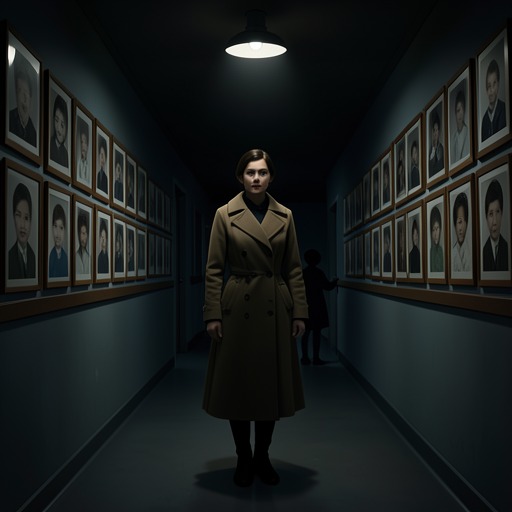
Sarah escapes the chapel with Dinah and leads Howard away
Down Cemetery RoadSarah escapes the chapel with Dinah Singleton and leads Howard away at a moment when protecting the child means leaving her briefly behind. Zoë Boehm’s order sends them out of The chapel in the woods; once Howard appears, Sarah turns her escape into a diversion, drawing the armed pursuer into the trees and away from Dinah.
The decision to leave
The choice begins inside the chapel, amid the immediate danger of the confrontation. Michael Downey has ordered that a man be killed, Sarah Trafford says the weapon did not fire, and Zoë Boehm recalls her rule of leaving the chamber empty. Zoë then tells Sarah to get out, and makes the instruction specific: take Dinah Singleton and go. Amos Crane repeats the phrase about the empty chamber, but Sarah’s attention is already fixed on Zoë’s command and the child’s safety.
Sarah hesitates, asking what will happen, but Zoë insists. The repeated command changes the scene from a confrontation Sarah might still try to influence into a choice she must make for herself and Dinah. Sarah obeys without stopping at the door to look back. That abrupt departure is significant: she does not wait for reassurance or for the danger inside to be settled. Zoë’s words become an action through Sarah’s immediate response, carrying the child out of the room and into the open.
Outside with Dinah
The space outside seems almost impossible to reconcile with the danger inside. Sunlight has appeared; leaves color the air green, and bushes push through stony ground beside a stained-glass window. A blue 2CV sits half parked in a ditch. The contrast gives Sarah and Dinah a possible route away, but it does not make the choice simple: Sarah cannot go back inside with Dinah, and she will not leave her alone outside.
Sarah acts on what the narration calls automatic. She opens the car’s back door, puts the grizzling child on the seat, leans forward, and brushes Dinah’s hair with her lips. Her soothing words promise that things will be all right and that they are both going away. The small gesture of affection sits beside the urgency of her movements: she is trying to comfort Dinah while thinking through what can be done next.
Her first plan is to walk to the main road and flag down a lift. She abandons it almost as soon as it forms, remembering how the last lift turned out. That recollection makes the ordinary solution of asking for help feel unsafe. Before she can settle on another plan, her attention catches movement among the trees: a shape moving out of rhythm with the other shadows, then the recognizable shape of a man.
Howard appears
The man is Howard, whom Sarah recognizes as the man from The island. He is carrying a gun. Sarah shuts the front door of the car and moves around to the back, continuing to rely on automatic actions rather than pause to deliberate. She opens the boot expecting it to be locked, then expecting the weapon to be gone; neither expectation proves true. The Shotgun is there, and although she doubts that she will be able to use it, she picks it up.
Sarah turns and points the Shotgun at Howard. His response is slight, an outwardly minor reaction that offers no assurance that he will stop. More important to Sarah is a soft thump from behind her, possibly Dinah falling off the seat. The sound fixes her priority: whatever happens next must not happen near the child. She judges that Dinah is safer alone in the car than exposed to the coming confrontation, and runs into the trees.
The diversion and its cost
Sarah does not know what she will do if Howard follows, but she also does not know what she would do if he stayed. The uncertainty does not prevent her from making the choice that gives Dinah distance from him. She waits in the clearing for the beat of her heart; Howard then sets off after her. The chase confirms that the diversion has worked in its immediate purpose: Howard is following Sarah, not approaching the car.
He still has his gun, but does not fire. Sarah still has the Shotgun, yet knows she cannot use it herself. Her memory goes to another copse, where Michael Downey made her aim and shoot, and where the blast tore through leaves and branches as though they offered no resistance. The recollection does not make her willing to shoot a person. Instead, it sharpens the gap between possessing a weapon and being able to use it: Sarah carries the Shotgun into the woods without believing it will make her safe.
Her last thought turns the flight into a stark calculation. If Howard kills her, what would stop him from killing Dinah too? The danger to the child remains present even as Sarah runs away from her, and the scene does not resolve whether she can defeat Howard or return to Dinah. Its decisive action is narrower and more immediate: Sarah chooses to draw the armed man away, accepting the danger herself in the hope of keeping it from the child.